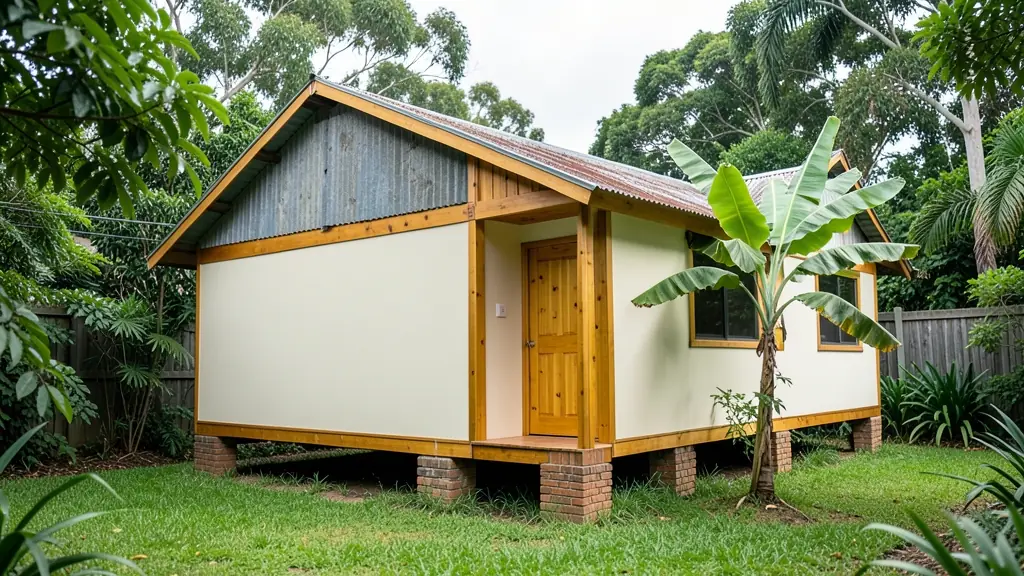
Builders use the name nutec wendy houses for a mixed building: the timber frame and often some pine of a traditional wendy, with fibre cement boards on some or all of the outside walls. It suits people who like the price and speed of a wendy but worry about rot, borer and termites in the cladding. Exactly what counts as a hybrid differs between suppliers, so the details matter. Describe what you want, and we pass it on to independent builders near you who quote you directly.
What the word hybrid can mean
Ask three suppliers and you may hear three versions:
- pine planks inside, fibre cement boards outside, on a timber frame
- fibre cement walls with pine gables, doors and trim
- a standard pine wendy with fibre cement only on the weather side
None of these is wrong, but they are not the same building. Ask for a drawing or a photo of the exact unit, and a list of which walls get boards and which get planks. Ask as well about the board thickness, how the joints are covered and whether the inside of a board wall is lined or left as bare frame. A hybrid with exposed studs inside is fine for a store, but not for a bedroom.
Compared with an all-pine wendy
The boards do not rot or attract termites, so the walls that take the rain and sun tend to need less work. Paint suitable for fibre cement lasts well on them, while pine needs sealing at the interval the maker gives. The hybrid usually costs more than a pine wendy house of the same size. It can also be heavier to move. The frame is still timber, so it still needs to be treated and kept off the soil.
Compared with a full nutec house
A full nutec house is often built more like a small home, with insulation, ceilings and internal walls of board or gypsum. A hybrid is usually closer to a wendy in how it is made and sold: standard sizes, panels delivered on a truck and erected in a day or a few days. That keeps the price down, but check whether insulation or a ceiling is included, because many hybrids come without either unless you ask.
Where hybrids make most sense
They work well as a backyard room to rent, a spare bedroom, or a store in a garden where termites have eaten pine before. In wet areas, cladding the most exposed walls in board can save a lot of maintenance. If you want to move the building later, ask whether the panels are made to come apart, and read the removals page before you buy. Boards are heavier and more brittle than planks, so a hybrid panel needs careful handling on the truck.
What to put in your request
- The size you want in metres
- Which walls should be board and which pine
- Whether you need insulation or a ceiling
- The floor: timber on bearers or a concrete slab
- Your suburb and access to the backyard
Nutec Wendy Houses for homes, landlords, farms, schools and sites
- Homeowners: a 3 x 6 m hybrid room for a teenager, board walls outside and pine planks inside
- Landlords and backyard rentals: a backyard hybrid unit to rent that needs less sealing than pine between tenants
- Farms and smallholdings: a store or tack room with fibre cement walls where termites have damaged pine before
- Schools, crèches and training centres: a crèche storeroom with board walls that take paint and knocks better than planks
- Small businesses and home offices: a hybrid office or stock room at the back of a small shop with a lockable door
- Construction and mine sites: a guard hut with fibre cement walls on a timber frame, easy to load on a truck
- Guesthouses, campsites and resorts: a garden staff room or laundry clad in board to match the main buildings
- Churches, clinics and NGOs: a church store or soup kitchen room with walls that wipe clean and resist fire better
- Builders, developers and installers: fibre cement cladding fitted over existing wendy frames as a subcontract job