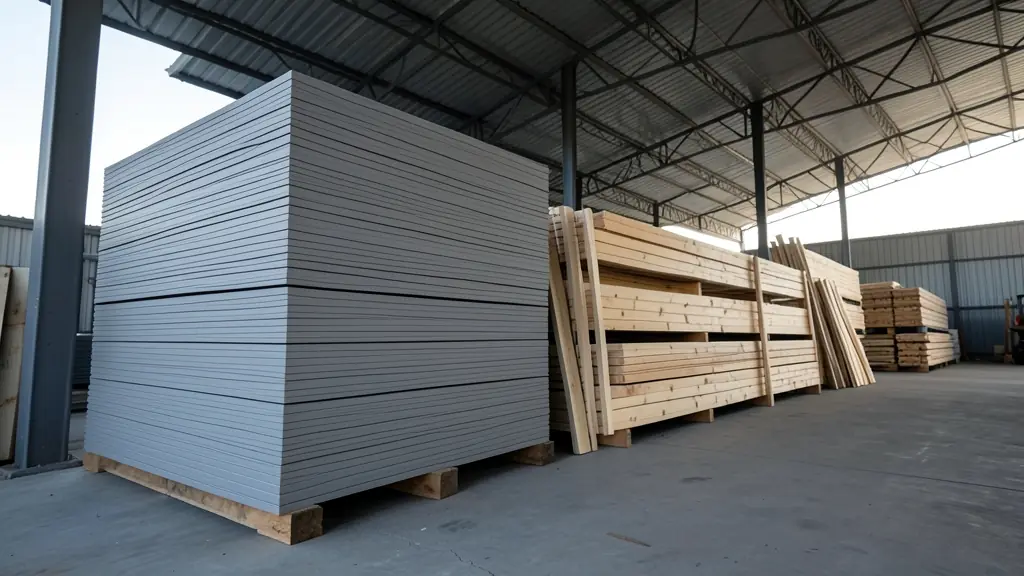
Nutec boards are fibre cement sheets: a mix of cement, fibres and fillers pressed into flat panels. The word started as a product name, but in South Africa people use it for almost any fibre cement board, and for the houses clad in them. Builders use the boards for outside walls, inside walls, ceilings, eaves, garden sheds and even gate infills. They do not rot or feed termites and they take paint well. They do need sealed joints, the right fixings and careful cutting. Send one request and board suppliers near you can quote.
Thicknesses and where each goes
Suppliers sell the boards in standard sheet sizes and several thicknesses. As a rule, the thinner sheets are for ceilings and inside walls, and the thicker ones for outside walls, where they take knocks and weather, and for floors. There are also textured and wood-grain faced boards for cladding, and narrow planks of fibre cement that are fixed in overlapping rows like weatherboard. Tell the supplier what the board is for and the stud spacing of your frame, and ask which thickness they would sell for that. For whole buildings, see nutec houses.
Cutting without breathing the dust
Fibre cement dust contains silica, which harms the lungs. Follow the maker's instructions every time. In practice that means:
- Cut outdoors, with the wind behind you, and wear a proper dust mask and eye protection.
- For straight cuts, score deeply with a scoring knife and snap the sheet over an edge.
- For other cuts, use a saw with a blade made for fibre cement, ideally with dust extraction.
- Wet down and sweep up the offcuts and dust, rather than blowing them around.
Fixing, joints and gaps
Use the screws or nails the board maker specifies, at the spacing and distance from the edge they give. Fixing too close to an edge can crack the board. Leave the small gap at joints that the instructions call for, so the sheets can move with heat, and either seal the joint with a flexible sealant or cover it with a strip. Outside, a membrane behind the boards and flashing over windows keep water out. A frame that is not straight will show through, so check the studs first (our timber frame page covers frames).
Painting and small uses
Fibre cement can be left plain, but most people paint it with a paint made for fibre cement, often after a primer. See wendy house paint for the coats. Off-cuts and single sheets are handy for a garden shed, a wet-area wall, a braai surround panel or filling a steel gate frame for privacy. For a gate, ask about a thicker board and fixings that will not rust.
What to put in your request
- Number of sheets and the thickness you need
- What the boards are for: walls, ceiling, gate
- Whether you want screws, strips or sealant too
- Collection or delivery, and your area
- Any cutting service you would like
Nutec Boards for homes, landlords, farms, schools and sites
- Homeowners: a few sheets to clad a garden shed or line the inside of a wendy house
- Landlords and backyard rentals: enough outside wall boards to clad two backyard rental rooms on a timber frame
- Farms and smallholdings: boards for a feed store or tack room that rats and termites cannot chew through
- Schools, crèches and training centres: ceiling boards to finish a classroom so it stays cooler in summer
- Small businesses and home offices: boards for a spaza or a workshop wall that can be painted and wiped clean
- Construction and mine sites: sheets to close in a guard hut or a site store on a steel frame
- Guesthouses, campsites and resorts: textured cladding boards for a guest unit that matches the main house
- Churches, clinics and NGOs: boards for a clinic room or church hall extension that resists fire better than pine
- Builders, developers and installers: a regular supply of sheets in two thicknesses, delivered to different sites