
Understanding Nutec Houses: Features and Construction
Material Composition and Structural Benefits
Nutec boards combine cement and wood fibre into a composite panel that resists fire, rot, and termites. The sheets attach to a galvanised steel frame, which means the structure goes up quickly and does not require massive concrete foundations. That efficiency has a direct effect on 1 bedroom nutec houses prices, since labour and material costs stay contained.
The insulating layer sits between the exterior cladding and interior lining, keeping the heat out during Durban summers and trapping warmth on cold Cape evenings. The steel frame holds its shape against shifting soil, so cracks and warping are less common than with brick houses.
Buyers typically receive these components with a standard package:
– Pre-cut Nutec wall panels
– Galvanised steel framing sections
– Roof sheeting and fasteners
– Window and door frames
This prefabricated approach explains why 1 bedroom nutec houses prices remain competitive against conventional brick and mortar alternatives.
Standard Design Dimensions for Compact Living
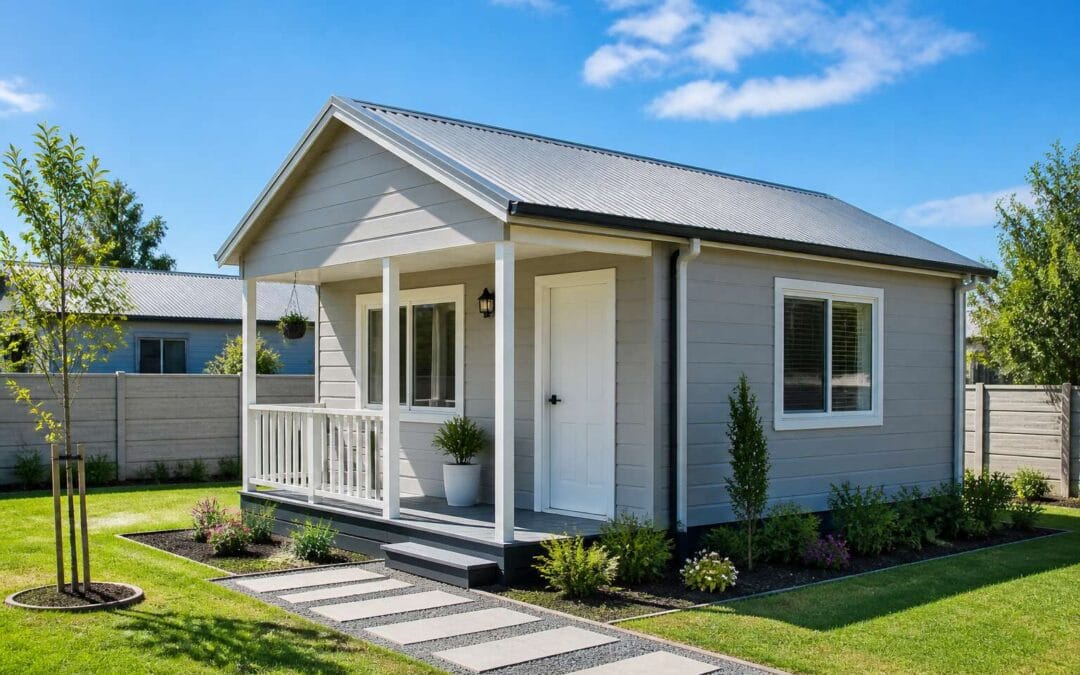
Across South Africa, the standard 1 bedroom nutec house footprint measures roughly 42 square meters. The design uses this area without wasted corridors or dead corners. The bedroom sits behind a pocket door, the living space feeds into a galley kitchen, and the bathroom tucks neatly beside the entrance.
Ceilings reach 2.4 meters, and windows follow the prevailing breeze. A covered stoep extends the usable area without adding to the enclosed footprint. These dimensions keep construction efficient, and this efficiency holds 1 bedroom nutec houses prices steady when material costs fluctuate. For first time buyers, 1 bedroom nutec houses prices become the reference point.
The typical layout breaks down like this:
- Open plan living and dining zone: roughly 15 square meters
- Separate bedroom with built in wardrobe space: 9 to 11 square meters
- Compact bathroom with shower, basin, and toilet: 3 square meters
Compact living, executed with precision, becomes clarity!
Durability and Insulation Performance
A nutec wall handles rain, humidity, and wind-blown dust without swelling or warping. That matters along the coast, where salt air attacks ordinary cladding. The factory cured surface holds its shape through hot summers and wet winters. Repairs stay rare, and this reliability keeps 1 bedroom nutec houses prices steady.
Insulation is another strength. The wall panels contain a dense foam core that slows heat transfer. A 1 bedroom nutec house warms quickly on a cold Johannesburg morning and stays comfortable through the afternoon heat. Bedrooms remain tolerable, even when the sun hits the western elevation.
The construction adds practical layers:
- Weatherproof flashing seals every wall joint
- Roof overhangs keep rain off the panels
- Sealed window frames cut draughts and noise
These extras lower monthly energy consumption. Smaller utility bills matter to first time buyers. That combination of low upkeep and thermal comfort explains why 1 bedroom nutec houses prices remain competitive across South Africa’s housing market.
Maintenance Requirements and Lifespan
Nutec houses go up quickly because the panels arrive pre-cut and ready to fix. A small crew can complete the shell in days, which keeps labour costs down. That speed matters when you calculate the final figure for 1 bedroom nutec houses prices.
Maintenance stays simple. Wash the panels occasionally, check the sealant around windows and doors, and repaint when the factory finish fades after many years. There is no rotting timber or rusting sheeting to replace.
- Inspect roof flashing every two years
- Reapply silicone sealant to joints as needed
- Clean gutters before the rainy season
With this basic care, a Nutec house easily lasts decades. The lifespan rivals brick and mortar, while 1 bedroom nutec houses prices remain far gentler on a first time buyer’s budget.
Price Determinants for One-Bedroom Nutec Homes
Foundation and Site Preparation Costs
The true variable in 1 bedroom nutec houses prices often lies underground. Two homes with identical floor plans can differ meaningfully in final cost because of what sits beneath them. South African sites range from stable, compacted ground to rocky outcrops or waterlogged clay, and each demands a unique engineering response.
Foundation choice dictates much of the budget. A simple strip footing suits level plots with competent bearing capacity. A reinforced raft slab becomes necessary where soils shift or where the site has been previously backfilled. Piling, though rare for a small home, may appear when the building line falls on a slope.
– Site clearing and levelling
– Geotechnical soil testing
– Access for ready-mix concrete trucks
– Municipal approval and inspection fees
Each line item reshapes the total. A 1 bedroom nutec house price only begins to make sense once these ground conditions are fully understood.
Customization Options and Finish Levels
The choices made after the concrete cures are where the true character of a home emerges. For 1 bedroom nutec houses prices, the variance between a bare shell and a finished dwelling can be startling. A simple, honest interior with painted walls and standard fixtures carries one cost. The same floor plan, dressed in stone countertops, acoustic ceilings, and brass hardware, carries another entirely.
Customisation is a spectrum. Some owners choose a single room configuration with a modest bathroom. Others extend the footprint or demand thermally broken windows to quiet the midday heat. The finish level dictates labour hours. Tiling, joinery, and plumbing fittings each whisper their own price into the final tally.
- Standard paint versus textured plaster
- Vinyl flooring versus ceramic tile
- Basic shower units versus frameless glass
The phantoms in the budget are seldom the materials. They are the thresholds between standard and bespoke, where a single preference shifts 1 bedroom nutec houses prices more than any foundation survey.
Labor and Assembly Expenses
Assembly wages are the quiet expense in any prefab undertaking. In South Africa, labour rates for Nutec installation swing sharply between metros and platteland towns, and those swings land squarely in the final tally for 1 bedroom nutec houses prices. A Durban crew and a Polokwane crew will quote differently for the same floor plan, often by a startling margin.
The kit itself is only half the story. Every panel needs two or three pairs of hands, and every joint demands patience. Owners forget that labour accounts for nearly a third of the outlay.
- Number of crew members required for safe panel handling
- Travel and accommodation for crews in remote areas
- Certification fees for the electrician and plumber
That last line item stings more than the materials.
Permit and Regulatory Fees
The municipality’s stamp is the invisible line item in 1 bedroom nutec houses prices. Building plan approval fees in South Africa run through a labyrinth of municipal departments, each with its own appetite for paperwork. I have watched owners underestimate this phase entirely.
Some councils charge a percentage of the build value, others a flat tariff. The variance is astonishing. The hidden costs rarely stop at the plan approval itself:
- Electrical certificate of compliance fees
- Plumbing certificate requirements
- Property boundary and zoning verification charges
These regulatory layers add between R8,000 and R25,000 to the final figure depending on your council. That is before any inspector demands a revision.
Comparing Costs: Nutec vs Other Building Materials
Cost Comparison with Brick and Mortar Structures
The gap between Nutec and brick is not subtle. It is measured in rands per square meter, and the numbers tell a clear story. When comparing 1 bedroom nutec houses prices to brick and mortar equivalents, the material cost alone can differ by nearly half.
A standard brick wall needs multiple layers: structural bricks, mortar bedding, plaster, and a painted finish. Nutec boards arrive prefinished and install directly onto the frame. This removes entire stages of the building process.
Consider the material cost breakdown:
– Nutec board: R180 to R250 per square meter
– Brick and mortar wall, plastered and painted: R350 to R500 per square meter
– Finishing materials for brick: R80 to R120 per square meter extra
The thinner profile of Nutec walls also means more usable floor area per square meter of foundation. That efficiency flows directly into 1 bedroom nutec houses prices, making them a practical option for budget conscious buyers.
Cost Comparison with Wooden Houses
When weighing the financial merits of a timber frame against a Nutec structure, the scale tips in an unexpected direction. While wooden houses often present a lower initial quote for raw timber, the true cost emerges over time. For 1 bedroom nutec houses prices, the comparison with wood becomes a study in lifecycle expenses, not just the sticker price. Treated pine requires ongoing chemical protection against borer and rot, a recurring cost that slowly erodes its early savings. Nutec, conversely, offers a fixed, predictable expense. The installation time also differs, with timber frames demanding skilled carpenters for longer periods, driving up labour costs. In my experience, the total outlay for a wooden home can surpass a Nutec equivalent within a decade of ownership. Consider these factors:
– Pest treatment and fumigation: R15,000 to R25,000 over ten years
– Timber cladding replacement in high humidity areas: R30,000 or more
– Regular repainting and sealing of wood surfaces: R8,000 every five years
These hidden charges rarely appear in the initial comparison. The 1 bedroom nutec houses prices remain stable, while wood’s true cost fluctuates with the market for preservatives and skilled labour. For the budget conscious buyer, that stability is a quiet form of wealth.
Long-Term Energy Efficiency Savings
On the South African highveld, the true cost of a home shows up in winter electricity bills. When comparing 1 bedroom nutec houses prices with alternatives like unplastered concrete block or corrugated iron, the energy efficiency gap becomes obvious. Nutec panels, when paired with proper ceiling insulation, do not radiate cold like metal sheeting does.
- Concrete block walls transfer cold, increasing heater usage.
- Corrugated iron roofs raise indoor temperatures sharply.
- Nutec’s dense fibre cement composition moderates temperature swings.
Over five years, the electricity saved can reach R12,000. That changes the financial picture. The initial 1 bedroom nutec houses prices might sit slightly higher than a cheap zinc structure, but the monthly energy costs tell a different story.
Resale Value and Insurance Premiums
Resale value changes the financial picture in ways the initial quote cannot show. A 1 bedroom nutec house attracts buyers who have already researched energy bills. The asking price often sits closer to brick than the initial 1 bedroom nutec houses prices suggest, and that gap narrows further on the resale market.
Insurance companies also take notice. Nutec’s fire resistance and wind resilience frequently translate into lower premiums than corrugated iron or untreated timber. Concrete block homes might inspire confidence, but their rates rarely beat fibre cement. When insurers price a policy, they weigh:
- Fire resistance of the cladding
- Wind load ratings in severe storms
- Termite resistance versus timber frames
Across the highveld, estate agents report that nutec properties spend fewer days on the market. Combined with lower premiums, the resale advantage makes 1 bedroom nutec houses prices look increasingly reasonable over time.
Financing Options and Budget Planning
Mortgage and Personal Loan Alternatives
Financing a 1 bedroom nutec house demands a real look at your cash flow. Mortgages suit buyers with steady salaries, but personal loans move faster for compact builds. The total often lands below R250,000, which makes a personal loan tempting.
Compare interest rates side by side. Bond originators add transfer costs and monthly insurance. Personal lenders charge higher interest but skip bond registration fees. These factors shape your monthly budget:
– Deposit size
– Loan term
– Credit score
– Site preparation extras
Run the numbers before signing anything. 1 bedroom nutec houses prices may seem modest, yet hidden financing costs shift the final figure. Choose a loan structure that matches your income, not just the lowest advertised repayment.
Government Housing Subsidies and Grants
Government housing subsidies alter the affordability picture for 1 bedroom nutec houses prices. The Finance Linked Individual Subsidy Programme provides grants for first time buyers with household incomes below R22,000 per month. This grant covers part of the purchase price, shrinking the deposit burden.
Consider these steps when applying:
- Verify your income threshold
- Register on the national housing needs database
- Submit your approval letter to the seller or bond originator
Local municipalities occasionally include nutec homes in state funded projects. A subsidy of R50,000 or more changes the loan amount significantly. Budget planning becomes simpler when the state absorbs part of the cost. Check your qualification before finalising any price agreement.
Creating a Realistic Cost Breakdown
Understanding the true outlay for 1 bedroom nutec houses prices means looking past the sticker amount. Bond registration, transfer duties, and valuation fees often add 10% to 15% on top of the purchase figure. I always advise clients to build a buffer for these hidden costs before approaching a lender.
- Deposit and bond initiation fee
- Legal and conveyancing charges
- Municipal clearance and utility deposits
Your credit profile directly shapes the interest rate you secure, which alters monthly repayments far more than the base price. A realistic cost breakdown starts with your available deposit, then maps every legal and administrative expense. Many buyers overlook moving costs or temporary accommodation during transfer. Once you list these components, you can negotiate with genuine confidence. The final loan amount depends on your debt-to-income ratio, not just the seller’s asking figure. Prepare for these variables, and you will avoid the stress of unexpected shortfalls.
Hidden Costs to Anticipate
A single percentage point shift in the prime rate can add hundreds of rands to your monthly bond repayment, a reality many buyers forget when they see 1 bedroom nutec houses prices! Choosing between a fixed and a variable rate is the first decision. A fixed rate offers certainty, but a variable rate often starts lower. I always advise clients to stress test their budget against a 2% rate hike.
Hidden costs exist within the financing structure itself. You must budget for mandatory building insurance, which the bank will enforce. Bond account fees appear on your statement every month. An interest rate hike buffer is not a luxury, it is a necessity.
- Mandatory building insurance
- Bond account monthly fees
- Interest rate hike buffer
These items are often absent from the initial quote, yet they directly affect your cash flow. Understanding these variables ensures your budget planning aligns with the true monthly outlay for 1 bedroom nutec houses prices.
Payment Plans and Installment Schemes
Your payment structure sets the financial rhythm for the next two decades, and it deserves as much scrutiny as the building itself. Many developers of 1 bedroom nutec houses prices offer staggered payment schemes, where a deposit of 10% anchors the deal and progress payments follow each construction milestone. Bridge financing often fills the gap when you purchase the land separately from the build contract.
Installment schemes vary in ways that materially change your outlay. Bond instalments typically run monthly, yet some lenders permit biweekly payments that shave years off the loan term and reduce interest compounding. A larger deposit lowers your loan quantum, but a smaller deposit frees capital for furniture and moving costs.
- Fixed monthly instalments over a 20 year bond
- Interest only payments during the build phase
- Balloon payment structures with lower monthly amounts
Each mechanism alters the true cost of 1 bedroom nutec houses prices, so test every scenario before signing.
Regional Price Variations and Market Trends
Urban vs Rural Location Impact
In Gauteng’s metropolitan hubs, where land is at a premium, 1 bedroom nutec houses prices climb due to municipal connection fees and congested delivery routes. The same structure may cost 18% less on the platteland, where site preparation is simpler and local contractors compete fiercely.
What fascinates me is the steady drift toward peri-urban zones. Buyers in Mpumalanga and Limpopo now seek smallholdings within commuting distance of towns, balancing affordability against access to schools and clinics. This shift has pushed prices upward in those corridors!
A recent survey of provincial listings shows:
- Western Cape coastal towns command a 12 to 15% premium over inland areas.
- Free State and North West offer the most forgiving entry points.
- KwaZulu-Natal’s rural districts show the widest price spread, from R280,000 to R420,000.
Regional Pricing Disparities Across States
Across South Africa, the same floor plan wears different price tags. A 1 bedroom nutec house in the Western Cape’s coastal towns carries a premium that inland regions cannot justify. The demand from semigrants and limited coastal land have distorted the market.
Provincial data reveals stark separations. Gauteng’s urban metros push 1 bedroom nutec houses prices upward with municipal connection fees and delivery congestion. The Free State and North West offer the most forgiving entry points for first-time buyers. KwaZulu-Natal’s rural districts show the widest price spread, from R280,000 to R420,000.
- Western Cape coastal towns command a 12 to 15% premium over inland areas.
- Mpumalanga and Limpopo peri-urban corridors show steady upward drift as buyers seek smallholdings near towns.
Buyers tracking 1 bedroom nutec houses prices must watch provincial listing trends rather than national averages.
Market Demand and Supply Fluctuations
A quiet paradox haunts 1 bedroom nutec houses prices: supply contracts exactly when demand swells. In coastal nodes, speculative buyers reserve units off-plan, shrinking the visible stock and forcing late entrants to bid against semigrants. This creates a lag effect where prices rise on urgency rather than construction output.
Conversely, inland towns like Polokwane sometimes face gluts after bulk developers release phases too quickly. The resulting inventory drags the market sideways, and sellers wait months for absorption.
- Semigrant inflows spike during election years
- Rental demand surges with university intake dates
- Municipal approval backlogs compress available housing
These fluctuations mean 1 bedroom nutec houses prices respond as much to timing as to location. Tracking when buyers enter, not just where, reveals the real pressure points.
Future Price Projections and Investment Potential
Regional pricing shifts across South Africa reveal distinct investment stories. In coastal metros, 1 bedroom nutec houses prices climb at higher rates due to land scarcity. Inland hubs like Mbombela show steadier appreciation, while smaller Karoo towns lag.
Future projections suggest that as semigrant demand spreads, 1 bedroom nutec houses prices in secondary nodes will outpace metro growth. Investment potential remains tied to municipal infrastructure rollouts. For example:
- Johannesburg suburbs see moderate gains.
- Gqeberha offers entry level yields.
- Polokwane faces oversupply risk.
Buyers tracking these regional variations capture value before revaluation cycles turn.